Visualizzazione post con etichetta baba. Mostra tutti i post

domenica 16 gennaio 2011

Conversion of Energy - Demonstration by Baba


This demonstration was given by Shrii Shrii Anandamurti on 1969 in Ranchi and it is pubblished in the book Ánanda Vacanámrtam (part 33)
----------------------------------------
One day Bábá was talking about the dilemma of the sense organ. Bábá said incidentally that there are certain aquatic animals unknown even to biologists, from whose bodies some kind of light emits. With the reflection of their light, they can see other creatures and objects around them. There are also, in less deep seas, some animals that generate electric lights to catch hold of their prey.

In this context, Bábá asked one sádhaka (spiritual practitioner) whether the human body can generate electric current or not. The sádhaka having failed to give a correct reply, Bábá explained that it was quite possible. He explained that in sádhaná human vital energy is converted into spiritual energy.

In our daily life we exhaust our vital energy and compensate the same by taking food, drink, light, air, etc. While working, vital energy is transformed into mechanical energy. The same vital energy can be transformed into electric energy also, but in that case, the body will be electrocuted and the person will die. Human vital energy can be converted into magnetic energy as well.

[The process of conversion can involve many possible effects.] In the case of conversion of vital energy into spiritual force, it does not affect the body and mind. But in the case of conversion of vital energy into magnetic energy, it does affect body, mind, etc.

Demonstration
Bábá told one sádhaka to take off his garments and sit on his woollen cloth without touching the ground (woollen cloth is a non-conductor). Then Bábá touched his right and left ribs and navel and told him to concentrate his mind.

After a few minutes, his palm was trembling. Then Bábá asked another sádhaka to [touch the left rib of the first sádhaka.]

The second sádhaka did so and felt an electric shock. Then three sádhakas more touched the first sádhaka’s body and felt the same kind of shock. Next Bábá took the sádhaka on his lap and rubbed his sweet hand on his body, hand, etc. Next Bábá touched him on the trikut́i (between the eyebrows) and helped him to go into a trance. This time his vital energy was reconverted into spiritual energy.

1969, Ranchi

Published in: Ánanda Vacanámrtam Part 33

venerdì 1 ottobre 2010

The Intuitional Science of the Vedas – 1


This discourse was given by Shrii Shrii Anandamurtiji on Shrávańii Púrńimá, during Dharma Maha Cakra in Monghyr (1955).

« In ancient times when the desire to worship awakened in the minds of the primitive people for the first time, at that initial stage they took men of great wisdom and strength as the objects of their adoration. Before this they had been Nature-worshippers or physiolaters. When their mental hunger was no longer satisfied by the worship of mountains and rivers, trees and creepers, forests and seas, dawn and dusk, or thunder and lightning they took their first step towards the contemplation of God through the medium of hero-worship. As a result, a kind of incarnation doctrine came into being, ascribing full Brahma-hood to an aspect of manifestation. This practice was adopted in the name of religion, and was popular in society for many generations after. But the urges of the human heart are limitless. The desire to know their inner nature led human beings to the philosophical path, and as a result of philosophical dissertation and discussion their way of thinking gradually changed. They began to think how it was possible to attain the beginningless, indivisible, super-exultant self through such unit-worship – through the worship of the finite. When the realization dawned in their minds, they felt a great agitation – a mighty inner stirring in their hungry hearts, a longing to know the beginningless, endless, unmanifest, all-pervading Entity. How and what is that which the mind will apprehend with its entire being?

The first hint of Brahmabhávaná or intuitional science was mentioned in the ancient writing of the Rgveda. That first seed grew into a huge tree in the Yajurveda with numerous branches and twigs. At that auspicious moment, human intellect saw through the radiance of its supra-mundane knowledge, through its clairvoyance, that whatever it wanted in the material world emanates from and belongs to the Supreme Absolute Bliss – all are but the unit-manifestations of the Supreme Entity. None of these are its whole self. But it cannot neglect these units, for they, too, are not outside it. They too, are an inseparable part of the Supreme Entity.

The common people could not grasp the deep Brahmatattva or Intuitional Theory, and so they tried to hold on to the superficial, extroversial trappings of religion such as sacrifices, rites and rituals, making them the medium for their religious expression. But wise and educated people realized that as a result of this worship of the crude, people with a developed intellect and consciousness would gradually revert towards crudeness and gradually be transformed into crudeness. We must however admit that it is not possible to give up the effort to attain the crude in the form of physical necessities. Nevertheless, having food and clothing and other physical needs cannot completely satisfy the hunger of the human heart. At different times human beings have gone without clothes or anything for years or voluntarily renounced the world when it proved antagonistic to the deepest urges of their heart. So it will not do for human beings to think only of providing themselves with the crude necessities. If anybody leads this type of life, they will never experience bliss – they will always feel inside them the aching void of the desert.

So human beings concluded after due cogitation: since it was not possible to give up the units and since they would have to go in for the “whole” after all, they would just as well forestall heir attachment for the finite by always keeping awakened in their minds, even while making use of the units, a sense of their being the image of that very Supreme Spirit. The pleasure-ward trend of the attachment would then be diverted towards the Bliss-ward course itself. By ascribing divinity to everything and thereby eliminating the limitedness of its littleness, humans would realize and enjoy the Supreme Bliss. In the Vájasaneyii Samhitá (Code) of the Yajurveda it is said –

Ishá vásysamidaḿ sarvaḿ yat kiinca jagatyáḿ jagat
Tena tyaktena bhuinjiithámá grdhah kasyasviddhanam.

This world is changing, moving. The word jagat (world) is derived from the root, gam-kvip, which means moving. This universe is the psychic manifestation of Brahma. All thought processes are moving and restive, and that is why this world, the psychic manifestation of Brahma. All thought processes are moving and restive and that is why this world, the psychic manifestation of Saguńa Brahma (the Subjectivated Transcendentality), is moving and restive. A thing that appears beautiful today is not necessarily so tomorrow. A sandesh (sweetmeat) that is delicious today will not be fit for consumption after a few days. Indeed one cannot even vouch for its shape still being intact. Every unit is in a state of change, and that is why the pleasure derived from unit objects cannot last permanently. So what should a Sádhaka (spiritual aspirant) do? He or she must ascribe divinity to every unit object. Everything is the manifestation of God. Whether it is land, home, river, mountain, respect, insult, day or night – everything is He and His manifestation as a unit. Make proper use of all objects thinking that they are His gifts to us. To enjoy or endure anything is to enjoy or endure Him. Avoid the attraction of the unit and make contact with the integral whole. When you are able to live this way, the desire to steal the property of others will completely disappear. In Ananda Marga there is a special process through which one can dedicate everything to God. The ascription of divinity to objects means the pursuit of the Infinite, leaving the finite behind. Are you feeding your son? No, no, you are feeding the son-like manifestation of Brahma. Are you tilling the field? No, no you are serving the finite manifestation of Brahma with your plough. Really speaking, the ascription of divinity to objects precludes their material enjoyment, as the objects then merge in the non-material Supreme Brahma. Thus the mind of one, who has established him or herself in real Vaerágya (the renunciation of all sensual pleasures) can never become attached to finite objects. Even in their midst he or she remains beyond the reach of their attraction and gains eternal peace after death.

No truck with water while I bathe
With hairs flowing free
Nor woes nor griefs shall ever scathe
Unwet I dip in sea.
Dedicated to God, night and day
Awake, asleep or dreaming be
No lures of world or desires gay
Dare ever come between He and me.


Do your work, but do not be caught up with it. A great man said, –

Grind spices or be a cook
Touch not the pan you ever
Dance a frog ’fore serpent’s hook
But let it not devour,
In the sea of nectar shall you bathe
Unwet shall remain your hair
Tie the elephant to a spider’s web
Love awaits you there.

Here the spider represents the little unit, the Sádhaka. A Sádhaka will realize what divine love is like only when he or she prepares the cobweb of devotion and ties the elephant, the Supreme Entity to it.

Life is intimately bound up with work If people do their work ascribing divinity to each object they are involved with, then, because of their non-attachment to material pleasure, they cannot be bound by the reactions of their actions. Life also cannot be the cause of such bondage, nor for that matter can the reactions of one’s actions be the cause of future lives. Otherwise a person who lives a long life will perform many actions, thus creating many reactions of greater sorrow to be experienced, and one will be a victim of the actional cycle life after life.

Kurvanneveha karmáni jijiivisecchataḿ samáh
Evaḿ tvayi nányatheto’sti na karma lipyate nare.


Always ideate on Brahma and nurture the desire to live for a hundred years. You will thus not get caught up in the reactions to your actions. This is the only way, by which you can save yourselves from the bondage of your reactions.

The ascription of Brahmahood to all activities is only possible for a Sádhaka – it is only possible through spiritual practices or the Sádhaná of the átman (soul). To establish oneself in Brahma is not possible through the Sádhaná of the mind, racing up and down at the beck and call of the senses. The person who busies himself with the Sádhaná of the mind instead of that of the Átmań is, in fact running after darkness or an uncertain future.

Asúryyá náma te loká andhena tamasávrtáh;
Táḿste pretyábhigacchanti ye ke cátmahano janáh.

Those who are sensually and materialistically inclined destroy themselves because through their actions they deny their own souls. Whether they profess to recognize the existence of the soul or not, their actions are certainly detrimental to their self-development. In this material world you may have come across many people who acknowledge the existence of Brahma, who say that they recognize the existence of soul, argue over it and are not afraid even to shed blood for the preservation of their religion, yet in their individual lives they are always chasing after sensual pleasures. They are of the above type. They gradually drift away from light towards darkness, regressing from a developed human life towards animal life. Although they have attained a human body, they have not shown any interest in behaving in a way that is worthy of a human being. The foremost duty of a human being is Brahma-sádhaná or the worship of God.

Essentially the soul and the Supreme Soul are the same. It is the objects of the mind that are different. A person whose mind has accepted the Infinite as its object has indeed identified himself with the Supreme Soul. Now the question may arise; when the Supreme Soul is infinite in nature, how does the distorted idea of individuality come about, and what relation is there between the unit-soul and this observable world? The Dharma or characteristic of an individual is to advance from the finite towards the infinite, from a part to the whole. This characteristic emanates from the desire to attain happiness – for self-preservation. As long as the goal is not limitless, one cannot gain the eternal happiness of all the imaginable and unimaginable entities. The Supreme Soul alone is beginningless and endless, and that is why limitless happiness is only possible through the Supreme Soul. The pain of losing unit objects is far greater than the pleasure they give us. The suffering that one sees in the world is merely the pain caused by that loss. But a persons of wisdom are never affected by the pain of loss for they know that the cause of all suffering is one’s own Saḿskáras. These Saḿskáras are the reactions resulting from one’s actions, past and present.

The Saḿskára born of pleasure and pain or the consequential momentum that creates the state of microcosmic subjectivity in the Macrocosmic Consciousness and stamps the Integral Body with the seal of limited unit-hood, has got its rudimental cause in the Saḿskáras acquired by the Supreme Being in the state of bondage. Actually, it would be more accurate to call it the mental reflection of action and reaction instead of calling it the distortion of the Supreme Soul.

The individuality of the unit is not complete in itself. So until one merges in the Whole Entity, one’s suffering cannot be alleviated. I have already said that the Sádhaka’s sufferings are caused by the Saḿskáras which one created oneself. One should therefore not be afraid of experiencing these reactions or accuse Brahma of injustice on this account. Humans very often complain, “God, so you had this in store for me. Is this my reward for so much worship and so much charity?” Such complaints are foolish, even sinful. At the time of suffering a Sádhaka should reproach himself for his past misdeeds and refrain from evil actions in order to avoid more suffering in the future. Everyone should bear in mind that as long as the fire of woes is not extinguished – so long as the Saḿskáras are not burned one has got to suffer. That is why I say you must not find fault with others because of your Saḿskáras; they are merely the reactions caused by your own mistakes and misbehaviour. Do you not see in the reflection the same wreath that you put around the neck of a shadow? Poet Vidyápati said:

Countless miles and ages lie
Life to life, between me and Him.
Dogged by Fate and here am I!
The fault not His, but mine and grim,


Don’t get upset over your suffering and difficulties. Learn from your painful experiences and acts, and behave wisely in your next life. Accept the beginningless and endless entity as the object of your ideation and behave accordingly.

Anejadekaḿ manaso javiiyo naenaddevá ápnuvan púrvamarśat;
Taddhávato’nyánatyeti tiśt́hat tasminnápo mátarishvá dadháti.


He is the only entity which does not move. Where there is no difference of places, there is no movement. How can the all-pervading entity in whom everything exists, have movement? He is faster than the mind, as the motive force that exists in His psychic body, i.e. the motive force of His thought process, dictates the movements of all the entities of the world; it is from this that they get the impetus to move. The senses are not capable of understanding. This is because the movement of the senses is towards objects, and so-called motionless objects are merely external forms of His mental expressions, His efferent thought-waves. His Blissful Entity is resplendent in its original state beyond the sphere of the mind. It is because of the cognitive Entity that life and energy exist in the world and that all processes of creation are continuing in a planned way.

Tadejati tannaejati tad dúre tadvantike;
Tadantarasya sarvasya tadu sarvasyásya báhyatah
.

He is moving. No, no, He is not. He is motionless like the stump of a tree. He is far away. No, no, He is not. He is very close. He is the life of my life. He is within you and me. He is inside and outside everything everywhere. When a Sádhaka becomes well-acquainted with His Blissful Entity, we say that he or she is established in Brahma. At that stage there is both internal and external unity. The mind remains indifferent to worldly attractions and one makes real acquaintance with the Supreme Being. Although the body remains in the mortal world, the soul is merged in the Supreme Soul. The mind then becomes unrecognizable. Whose mind is it after all? Poet Cand́idása has written, –

What pangs reside in Radha’s heart,
Unlistening she sits alone in solitude.
Even in reverie, her eyes fixed, skyward rest
Like a saffroned recluse, averse to food.
Unleashing strands, she watches the braid
Of her hair rich and flower-bedecked
With smiling gaze at the clouds staid
She whispers something with hands outstretched.
Like a pavonine couple, with eyes unmoved,
Exchanging thoughts with passioned glance,
Wooing Kaliya as though renewed,
Candidasa says, a novel stance.

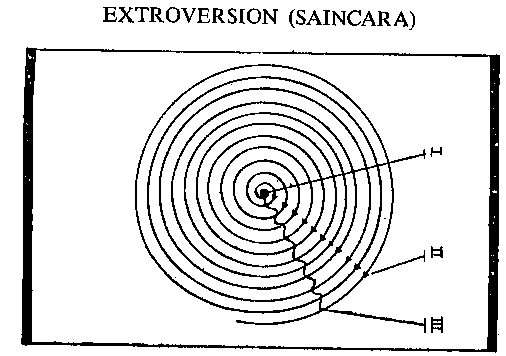
This manifestation of this observable world is called Saincara or Extroversion during its movement from the subtle to the crude, and the movement of the created units and the world from the crude to the subtle is called Pratisaincara or Introversion.


Thus goes the cycle of evolution from the subtle to the crude and from the crude to the subtle. The movement of the unit is from the crude to the subtle. The path comprised of the extroversial movement away from and the introversial movement towards Brahma, is called the Brahmic or Cosmic System, which is revolving under the forces of Saiṋcara and Pratisaiṋcara.

Under the influence of Vidyámáyá (Introversive Force or Force of Macrocosmic attraction) the unit activates the centripetal or introversive momentum of His thought-process through his Sádhaná, and by worshipping Avidyámáyá (Extroversive Force or Force of microcosmic distraction) he extends the centrifugal or extroversive action of His thought-process and prolongs its duration. In Vidyá cognition predominates, whereas in Avidyá there predominates action (Vidyá is a Cognitive force, and Avidyá is an activating force devoid of cognition). Cognition and action should be balanced in the life of a Sádhaka, or else it will be difficult to move towards Brahma.

Andhaḿ tamah pravishanti ye’vidya mupásate
Tato bhuyáiva te tamo ya u vidyáyáḿratáh.


The person who worships Avidyá drifts towards darkness and the person who worships Vidyá goes even deeper into the darkness.

Anyadeváhurvidayányadáhuravidyayá
Iti shushruma dhiiráńaḿ ye nastadvicacakśire.


Vidyá and Avidyá have contrary concomitants. Neither of them has equilibrated movements. People with calm and collected intellect, Sádhakas with developed intuition, who could very well understand such things due to their judgment, have made the above declaration with regard to Vidyá and Avidyá i.e. salvation is not possible through the cultivation of only one of these two principles. For the attainment of salvation, there must be balance between Vidyá and Avidyá to move forward. Although the movement towards Brahma must be introvertive (Vidyá), one should not give up Avidyá completely in relation to the practical world. This also has got to be made compatible with one’s own spiritual way of life by ascribing normal and divine bearing to it. Here the balance between Vidyá and Avidyá refers to the equitable conduct and behaviour during the period of material enjoyment.

Vidyá incávidyá inca yastadvedobhayaḿ saha
Avidyá mrtyaḿ tiirtvá vidyayá mrtamashnuvte.


It is those Sadhakas who are well-versed in intuitional knowledge, who are able to properly grasp this extroversive and Introversive Science. They do not deny any of the principles of creation, preservation and destruction. Forestall death through proper Karma-Sadhaná, a pursuit of action without denying it, and attain immortality through valid knowledge.

Yastu sarváńi bhútá ni átmanyevá nupashyati
Sarvá bhúteśu cátḿánam tato na bijugupsate.


A person who sees himself in everything and everything in himself can never hate anybody or anything. The capacity to overcome hatred is the main characteristic of Brahamajinána or one versed in intuitional science. Because of their pervasive egalitarian vision, there is not the slightest chance of their committing any sin in secret.

Yasmin sarváni bhútániátmaevábhúdvijánatah
Tatra ko mohah kah shoka ekatvamanupashyatah.


When the sense of persuasiveness of one’s soul in all living and non-living objects awakens in one’s mind, one neither hankers after anything nor is one afraid of losing anything. One feels a sense of oneness with all objects and attachment and grief fade away.

Sa paryagácchukramakáyamavraḿamasúviraḿ shuddhampápaviddham
Kavirmaniiśii paribhúh svayambhúryáthá tatyato’rthán vyadadháccháshvatiibhayah samábhyah.


The characteristic of that Supreme Being is its all-pervasiveness. The Sádhaka or the practitioner of intuitional science gets installed in Him, and with His bearing the sádhaka eventually identifies himself with Him. In that bearing of His abides the splendour of all-fulfilment – the seed of all-knowingness. “Tatra niratishavam sarvajinavijam.” The Supreme Being has no crude body. He is absolutely faultless, pure, sinless, all-mighty, all-observing, all-knowing, self-controlled and Svayambhú or self-creating. He is not comparable to anything or anyone – “Na tasya pratimá asti,”, i.e., He has no image. In Him there is unlimited forgiveness. From the very beginning He has been giving everything to the units and will continue to do so. Such, is the attitude of that Great Being. One who is dazzled by the superficial splendour of His creation and gets entangled in it through one’s extroversial tendencies forgets the great, noble Creator behind this creation. Is it not foolish to forget the Lord of the creation for the created? Mother is cooking. The son suddenly cries for his mother. Mother gives him a toy, and the son is so fascinated by the toy that he forgets all about his mother. But when a son does not forget his mother and stop crying in spite of the toy in his hand, then the mother is compelled to embrace him and take him on her lap.

The son, too, holds his mother with one hand, the toy with the other. God is compelled to surrender Himself to the wise Sádhaka, who does not forget Him for the love of this toy-like creation – who does not relax his efforts to attain God.

Andham tamah previshanti ye’ sambhútimupásate
Tato bhúya iva te tamo ya u sambhútyaḿ ratáh.


Those who run after Sambhúti or the glamour of creation and those who are obsessed by the fear of Asambhúti or the possibility of is destruction are both racing towards the world of darkness. A Sádhaka should look upon both Sambhúti and Asambhúti, i.e. creation and destruction, equitably and with equanimity. Scientists who are wholly and solely dedicated to the worship of Sambhúti and hermits who live in constant fear of destruction are both on the wrong path: they are not on the path of salvation. Only the person who uses judgement and accepts both of them attains immortality.

Sambhutiinca vináshainca yastadvedobhayaḿ saha
Vináshena mrtyuḿ tiirtvá sambhútyámrtamashnute.


One who knows the truth about creation and destruction gets established beyond the reach of death. The observable world is subject to creation and destruction. The movement from creation to destruction at first glance appears to be absolute, but the person who has understood the secret of creation and destruction and has thoroughly understood the world system, is alone able to establish him or herself beyond the range of this system.

The last hurdle on the path to the attainment of deathlessness and the realization of Brahma is the Hirańyamaya Kośa of the unit. As long as the Hirańyamaya Kośa exists, the Sádhaka cannot realize the Absolute Truth. The glamour of creation and the fear of destruction always upset a Sádhaka. The Supreme Being in His infinite glory is situated above the causal mind (Hirańyamaya Kośa).

Hirańmayena pátreńa satyasyá pihitaḿ mukham
Tattvaḿ púśannapávrńu satyadharamáya drśtaye.


O God! Remove the shining veil of Hirańyamaya Kośa, so that we may establish ourselves in Satyaloka (the region of Truth) Thy abode, so that our minds may not be attracted to the brilliance of the Hirańyamaya Kośa. This was all that was said about Brahma in the Ishopanisad.

When a person progresses from the crude to the subtle as a result of his Sádhaná, all the bondages gradually start disappearing by themselves, and when a strong desire awakens in the mind to attain that pure consciousness within, the Hirańyamaya Kośa also gets destroyed. In each of the five different stages of mind i.e. (1) Kámamaya Kośa (Crude or Conscious mind), (2) Manomaya Kośa (Subtle or Sub-conscious mind, (3) Atimánas Kośa (Supra-mental mind), (4) Vijinánamaya Kośa (Subliminal mind), (5) Hirańyamaya Kośa (Subtle-Cosmic Mind) – (the last three are collectively called causal or astral or unconscious mind) some sort of finite object directly or indirectly remains, and this object becomes the cause of bondage.

“Mana eva mauśya nám kárańam bandha mokśayo”. In other words the unit attains salvation only when she/he empties her/his mind of all objects. Just as an iron sword can perform acts of cruelty or merely cut the rope tethering and animal, similarly, according to its objective tendencies, the mind can also be the cause of both bondage and liberation.

All unit objects are external. Love for such unit objects can never be lasting, for the mind always keeps hopping from one object to another. That is why I say, withdraw your love from the unit and merge yourself in the whole. Don’t mistake the unit for the soul or God. The attainment of one’s inner self is only possible through love for the Infinite. Dońt pretend to be inferior and as a result become lazy. Fill your heart with love of the Infinite, and your soul will be transformed into the Supreme Soul. No worldly happiness is limitless. Dedicate yourself completely to the blissful ocean of the Supreme Soul. Then alone will you realize what happiness really is. This path to attain happiness, this Sádhaná of self-surrender I call absolute devotion. Carry on performing your worldly duties with sincerity, and at the same time think about the pure self within you. Then alone will your Sádhaná be justified. The constant thought of your pure inner Self will certainly one day establish you in your original source, and this is the ultimate aim of Sádhaná. The Soul is by nature characteristically pure. The mind gets tied to Saḿskáras (potential reactions) due to its actions, and that is why the unit becomes the slave of life and death. When all the Saḿskáras are destroyed through spiritual Sádhaná and mental purification, one goes beyond life and death to the eternal region of immortality, where there is no difference between the soul and His Supreme Soul.

Be all of you blessed with the greatest glory. Amen! »
-------------------------------------------------------------

Shrii Shrii Anandamurtiji on Shrávańii Púrńimá 1955 DMC, Monghyr

Published in:
Ananda Marga Ideology and Way of Life in a Nutshell Part 2 [a compilation]
Subháśita Saḿgraha Part 2

(^__^)

venerdì 11 giugno 2010

Kiirtana: the panacea for all afflictions


The Supreme Father is the Absolute Truth, the only Truth of the Universe. His creation undergoes transmutation, and thus it may be a moving reality, a relative truth, but not an absolute truth. The Absolute Truth is a singular entity; there cannot be two Absolute Truths, there cannot be two Fundamental Truths.

In the hub of this Absolute Truth there is no change and no movement, no absolute pause, no relative pause. But in the outer arena of the Hub, of the Causal Matrix, there is movement, but there is no second entity. This internal movement, although a movement, is as fundamental as the Absolute Truth.

But in the realm of creation there is relativity; and because there are relativities, that is why there are pains, pleasures, sorrows and afflictions. All human beings reside in that portion of the Supreme Body. But whether plants, animals or human beings, the goal of all is the Supreme Hub. And this pauseless movement towards the Supreme Nave is human progress, progress in the proper spirit of the term. This is spiritual life, and this life is the real life. It is the only path for human beings to follow; no other path can be accepted as the path of progress that does not lead to intellectual growth and spiritual elevation. Only that can be termed as genuine progress which elevates all aspects of human existence – physical, mental and spiritual – and makes them one with the Supreme. This is the path of Sádhaná.

In this path of your movement – and remember, movement is essential for you – sometimes obstacles arise, and in future will arise also. In this manifested world, different forces are acting and reacting; some of these forces help humanity in accelerating its movement, whereas some thwart the progress toward the Supreme. Spiritual aspirants will have to advance by fighting all these opposing forces. One should not be concerned about these; rather one should proceed on with greater firmness, smashing all obstacles and continuing tirelessly towards the Supreme Entity. One is sure to reach one’s destination. And what is the destination? To merge into Parama Puruśa, to sit on His Lap.

Along with the obstacles, there will also be certain forces which will assist you. Whatever worldly difficulties might obstruct your path, the best positive or auxiliary force is Kiirtana. Kiirtana helps a devotee to accelerate the speed towards the hub of the Universe. Kiirtana will help you all circumstances; if any mental trouble arises, kiirtana will help you.

People have to pass through so many relativities, so many troubles and afflictions, before attaining that supreme hub. Human beings are subject to triple afflictions – physical, psychic and spiritual – and the psychic and spiritual miseries are as painful as the physical ones.

Why do the spiritual afflictions arise? You know that you are the loving sons and daughters of Parama Puruśa. But you don’t feel Him always close to you, you cannot get the chance to sit on His Lap, and because of this you suffer from spiritual afflictions.

The supreme panacea to surmount all these triple afflictions is sádhaná. So all human beings must do sádhaná as much as possible; it is the main duty of the human life. If sádhaná is omitted, then one should omit one’s food and sleep also. Just as food and sleep are essential for human beings, similarly kiirtana, the most essential aid for sádhaná, should also be done whenever there is opportunity and time. The educated and uneducated alike should do it.

One must do kiirtana not only to surmount physical afflictions, but psychic and spiritual afflictions as well. It is the best medicine for all physical, psychic and spiritual ailments. It will bring about not only improvement in worldly life but success in the psychic and spiritual spheres. Kiirtana will help you in all circumstances, in all possible ways.

If people do kiirtana with distinct expression of the mantra, their mouths become pure, their tongues become pure, their ears become pure, their whole bodies become pure – and when so many parts of the body become pure, the átmá (self) also becomes pure. By kiirtana you become as pure as if you have taken a “holy dip in the Ganges.” What does a holy dip in the Ganges mean for a sádhaka? It means doing kiirtana constantly.

So instead of wasting your time in gossiping, in useless idle pursuits, you should do kiirtana even for two minutes or five minutes, whenever you get the opportunity. It is foolish to waste one’s valuable time in gossiping. One who has been blessed with a human body is not a fool but an intelligent person. Such people feel internally that they are the children of Parama Puruśa. Why should they waste their time?

By kiirtana you will always feel that you are not an insignificant creature, you are not inferior or low. Kiirtana will always remind you that you are the affectionate children of the Supreme. In kiirtana there is no restriction regarding time, place or person, no distinction between educated and uneducated, between black and white.

So do Kiirtana, sing kiirtana, chant Kiirtana, whenever and wherever possible.

- SHRII SHRII ANANDAMURTI - 15 May 1982, Calcutta

Published in:
Ánanda Vacanámrtam Part 22 [unpublished in English]

sabato 27 marzo 2010

If you're looking for inspiration, you found!


A deep and sincere Namaskar everybody, brothers & sisters all over the world.
If you're looking for inspiration, you found!
Here is the link to ALL the P.R. Sarkar/Shrii Shrii Anandamurti's english pubblications. Finding all books in alphabetical order, you will learn about Spiritual Philosophy, Social Philosophy, Education, Incredible Inspirational Stories, Children's Tales, Vegetarianism, Yoga, Meditation, etc..

Also avaiable in french and spanish.


Param'piita Baba ki, jayyy!!!

(^__^)

lunedì 8 marzo 2010

Cerebral and extra-cerebral memory


This story is called "Cerebral and Extra-Cerebral Memory" and it is taken from the magnificent and inspiring book of Dada Tapesvarananda "Living with Baba".
-------------------------

In the years 1969 and 1970, Baba gave many amazing demonstrations on different topics related to the laws of spiritual science. One day in 1969, we were with Him at Ranchi. There were just fifteen persons in the room. As we entered the room, Baba said, "Close the door."

We closed the door. Then, He told us, "Everybody should sit in a proper way and keep the backbone straight." Then, He called four particular persons to the front, close to Him. They were Dada Viirabhadraji, Dada Japanandaji, Dada Vandananandaji, and Sudhanshuji. Three were dadas while one was a Margii. They were all in a line in front of Him. Baba told them to repeat their Ista mantra. He said, "Today I will give a demonstration to show what cerebral and extra-cerebral memory is."

He explained that cerebral memory is the ability to think, remember and memorize something with one's brain about things that have happened in this life. Extra-cerebral memory refers to the ability to think, remember or memorize anything of one's past life with one's brain in this life. Hence, cerebral memory is common and every human being possesses it in the present life.

He said that a human being can remember his or her past life until the age of five years. But, due to the love and affection of the present father and mother, the child then forgets his or her previous life. After the age of five years, children cannot remember their past lives. If people can remember their past lives after the age of five years, then they are generally considered to be mad or abnormal.

The brain of this present life does not have the capacity to maintain two personalities. Nature has designed the body and brain in this way. For this very reason, even in this life, human beings forget many things, or we can say, most things. If a person remembers all happenings and events, all joys and sufferings in this life at a given moment, he or she may go mad. Nature has further designed the body in a way that the moment one sleeps, one becomes relaxed, because he forgets even very recent events. The mind gradually empties itself. Sometimes it happens that before the age of five years a child expresses the desire to do something, and the parents are not able to understand the desire of the child. Baba said that the time will come when science proves the reality of rebirth. And when science proves this fact, it will be the end or philosophical death of the so-called religions and of those who do not understand or believe in the science of rebirth. He said "You are not to do anything. Science will investigate whether or not there is rebirth."

Baba continued, "Now, what will I do? I will just remove the samskaras that have been accumulated in this life. Your existence in this life depends upon the samskaras." The mind cannot remain in the physical body without an object. The object comes according to the samskaras. As there will not be any samskaras, thus the reflection of the past life will come into their minds and brains even while they are in this life.

The first person was one brahmacari dada. Baba touched the ajina cakra of the dada using His stick, and then asked, "What you are seeing?" After a while dada said, "Black and red light, Baba."

Baba replied, "All right. If you try to see more it will be difficult for you to remain in this life." Then He told us, "Now I will give him back the samskaras from this life and he will be able to remember his Ista mantra." Baba told the dada to meditate.

The second person was another dada. Shrii Shrii Anandamurtijii touched his ajina cakra and asked him, "What you are seeing?"

That dada tried for more than five minutes to see something. Finally, he told Baba that he could not see anything at all. Baba said, "All right, now you meditate."

The third person was also a dada. Baba touched his ajina cakra, and likewise asked him, "What you are seeing?"
The dada replied, "I am seeing Baba in Janusparsha mudra." Baba told him, "All right, now you can meditate."

The fourth person, Sudhansuji, was a Margii from Ranchi. He was the District Secretary of Ranchi. By profession he was a school teacher and a very great devotee of Baba. Anandamurti touched his ajina cakra asking "What you are seeing?", he jumped up from the floor while making a loud sound like "Hum!" Again, Baba asked him, "What you are seeing?" Sudhanusji replied, "I am seeing Baba in Varabhaya mudra."

After that Baba instructed all the four of them to do sadhana. Then He explained the past lives of these four persons one by one.

Regarding the first brahmacari dada, Baba told us that in his past life he was a very simple and honest man. He used to live in a village. He had a tobacco shop. He used to sell tobacco, and was a smoker himself. One day, while he was smoking, he saw that the fire of the tobacco was very bright when he inhaled. The fire was less intense when he did not inhale. Suddenly he thought to himself, "My life is just like the fire. Somebody is controlling my life, just as I am controlling the fire. I don't know when the fire will finally go out, when it will extinguish itself. God is surely controlling my life in this way. I don't know where God is. I don't even know how to worship Him!" At that very moment as he was thinking of God, he collapsed and died.

Baba told us that this was indeed a very rare life within crores of lives. Then He said, "A man cannot get mukti or moksa without doing sadhana. How then did this brahmacari get rebirth as a renunciate, without either the desire or the samskara for such a rebirth? This dada had no samskara to be born into this life. In the past life, he did not even know what Yama, Niyama and meditation were."

Baba clarified that at the time of his death the man thought of God. He said that this type of soul could get rebirth only when Taraka Brahma comes to the earth in physical form. He got a physical body due to Baba's physical presence on the earth. In this life he is required to do both meditation and social service. Then he would get liberation in this life by the grace of Taraka Brahma.

For the second dada, Baba said that his life was practically in the same category as the first dada. He was not able to see anything because he had no samskaras. Shrii Shrii Anandamurtijii told us that in his previous life he was a village cultivator. He was also a very simple and honest man. From morning to evening he used to remain busy in agricultural work. Sometimes, he used to take his lunch in the field, and at other times in the house.

One day, he took his lunch in the house. After lunch, he went outside the house to wash himself. He had a matka, or water pot, in his left hand. As he came out of his house, he saw that the sun was beginning to set on the western horizon. Looking at the setting sun, he thought to himself, "What type of man am I? I do not remember when the sun rises and when it sets in the evening. For what purpose am I working, and for whom? The sun is now going to set and only now am I taking my lunch. One day my life also will end in a moment like this."

While thinking these thoughts he looked at the setting sun. Suddenly, he collapsed and died. Baba told us, "Without samskaras or desires, his soul was simply moving about in the universe. In this situation, neither can he get mukti nor can he get rebirth. For this reason, I brought him now to Me. He will have to do both meditation and social service, and then he will get liberation."

Regarding the third dada, Vandanananda Avadhuta, Baba told us that he had done meditation in his past life. He had then a Madhyama guru. Neither did he have a Sadguru, nor had he done any social service to humanity. Liberation was, therefore, beyond his reach. In this life he would have to do maximum social service and sadhana. Then, he would get liberation.

Now, regarding the last person, Sudhansuji, Baba told us that in his past life he had also done meditation. He then had an Uttam guru. His guru had told him that the Sadguru would in the near future come on the earth in physical form. Thus, this person developed a strong desire to see the Sadguru in physical form and to serve Him. Whenever Baba used to go Ranchi, this person used to serve Baba. When Anandamurtijii had dental and eye surgery at Ranchi, I was with Him. This Margii used to come every day early in the morning and stay the whole day in Baba's residence. Only at night would he leave and return home.

These incidents show that we are really His specially selected sons and daughters. We did not come to this earth by accident. Neither are we here to engage in worthless material pursuits and pleasures. We are here only to establish His Mission on earth.

(^__^)

giovedì 4 marzo 2010

Ánanda Sútram (chapter 5)


This version is the Shrii Shrii Anandamurti's Ánanda Sútram chapter 5, 2nd edition, 2nd printing, taken from present Electronic Edition.
-------------------------------------------------------------------

Chapter 5

5-1. Varńapradhánatá cakradháráyám.

[In the movement of the social cycle, one class is always dominant.]

Purport: Since no well-knit social order had evolved in the distant past, we may call that age the Shúdra Age; in those days all people survived by their manual labour. Then came the age of clan leaders – the age of the strong and the brave – which we may call the Kśatriya Age. This was followed by the age of intellectuals, which we may call the Vipra Age. Finally came the age of capitalists, the Vaeshya Age.

When the warriors and intellectuals are reduced to the level of manual labourers as a result of exploitation during the Vaeshya Age, shúdra revolution occurs. The shúdras have neither a well-knit social order nor sufficient intellect to govern society. Hence, the post-capitalist administration passes into the hands of those who provide the leadership in the shúdra revolution. These people are brave and courageous, so they begin the second Kśatriya Age.

In this way the Shúdra, Kśatriya, Vipra and Vaeshya Ages move in succession, followed by revolution; then the second cyclic order begins. Thus, the rotation of the samája cakra [social cycle] continues.

5-2. Cakrakendre sadvipráh cakraniyantrakáh.

[Located in the nucleus of the social cycle, sadvipras control the social cycle.]

Purport: Those who are staunch moralists and sincere spiritualists, and who want to put an end to immorality and exploitation by the application of force, are called sadvipras. They do not belong to the periphery of the social cycle because they are to control society remaining firmly established in the nucleus of the social cycle.

The social cycle will no doubt rotate, but if, due to their dominance, the warriors in the Kśatriya Age, the intellectuals in the Vipra Age or the capitalists in the Vaeshya Age degenerate into rapacious exploiters instead of functioning as benevolent administrators, the sacred duty of the sadvipras shall be to protect the righteous and the exploited and subdue the wicked and the exploiters through the application of force.

5-3. Shaktisampátena cakragativardhanaḿ krántih.

[Accelerating the movement of the social cycle by the application of force is called “evolution”.]

Purport: When warriors degenerate into exploiters, sadvipras will establish the Vipra Age by subduing the exploiting warriors. Consequently, the advent of the Vipra Age, which should have occurred through a natural process, is expedited by the application of force. A change of ages in this way may be called kránti [“evolution”]. The difference between evolution and svábhávika parivarttana [natural change] is only this: in evolution the movement of the social cycle is accelerated by the application of force.

5-4. Tiivrashaktisampátena gativardhanaḿ viplavah.

[Accelerating the movement of the social cycle by the application of tremendous force is called “revolution”.]

Purport: When a particular age is replaced by the successive age within a short time, or when the application of tremendous force is necessary to destroy the entrenched hegemony of a particular age, then such change is called viplava [“revolution”].

5-5. Shaktisampátena vipariitadháráyáḿ vikrántih.

[Reversing the movement of the social cycle by the application of force is called “counter-evolution”.]

Purport: If any age reverts to the preceding one by the application of force, such a change is called vikránti [“counter-evolution”]. For instance, the establishment of the Kśatriya Age after the Vipra Age is counter-evolution. This counter-evolution is extremely short-lived. That is, within a very short time this age is again replaced by the next age or the one after it. In other words, if the Kśatriya Age suddenly supersedes the Vipra Age through counter-evolution, then the Kśatriya Age will not last long. Within a short time either the Vipra Age, or as a natural concomitant the Vaeshya Age, will follow.

5-6. Tiivrashaktisampátena vipariitadháráyaḿ prativiplavah.

[Reversing the movement of the social cycle by the application of tremendous force is called “counter-revolution”.]

Purport: Likewise, if within a very short time the social cycle is turned backwards by the application of tremendous force, such a change is called prativiplava [“counter-revolution”]. Counter-revolution is even more short-lived than counter-evolution.

5-7. Púrńávartanena parikrántih.

[A complete rotation of the social cycle is called “peripheric evolution”.]

Purport: One complete rotation of the social cycle, concluding with shúdra revolution, is called parikránti [“peripheric evolution”].

5-8. Vaecitryaḿ prákrtadharmah samánaḿ na bhaviśyati.

[Diversity, not identity, is the law of nature.]

Purport: Diversity, not identity, is the innate characteristic of the Supreme Operative Principle. No two objects in the universe are identical, nor two bodies, two minds, two molecules or two atoms. This diversity is the inherent tendency of the Supreme Operative Principle.

Those who want to make everything equal are sure to fail because they are going against the innate characteristic of the Supreme Operative Principle. All things are equal only in the unmanifest state of the Supreme Operative Principle. Those who think of making all things equal inevitably think of the destruction of everything.

5-9. Yugasya sarvanimnaprayojanaḿ sarveśáḿ vidheyam.

[The minimum requirements of an age should be guaranteed to all.]

Purport: Hararme pitá Gaorii mátá svadeshah bhuvanatrayam. That is, “Supreme Consciousness is my father, the Supreme Operative Principle is my mother, and the three worlds are my homeland.” The entire wealth of the universe is the common patrimony of all, though no two things in the universe are absolutely equal. So the minimum requirements of life should be made available to everybody. In other words, food, clothing, medical treatment, housing and education must be provided to all. The minimum requirements of human beings, however, change according to the change in ages. For instance, for conveyance the minimum requirement may be a bicycle in one age and an aeroplane in another age. The minimum requirements must be provided for all people according to the age in which they live.

5-10. Atiriktaḿ pradátavyaḿ guńánupátena.

[The surplus wealth should be distributed among meritorious people according to the degree of their merit.]

Purport: After meeting the minimum requirements of all in any age, the surplus wealth will have to be distributed among meritorious people according to the degree of their merit. In an age when a bicycle is the minimum requirement for common people, a motor vehicle is necessary for a physician. In recognition of people’s merit, and to provide the meritorious with greater opportunities to serve the society, they have to be provided with motor vehicles. The dictum “Serve according to your capacity and earn according to your necessity” sounds pleasing, but will yield no results in the hard soil of the earth. (1)

5-11. Sarvanimnamánavardhanaḿ samájajiivalakśańam.

[Increasing the minimum standard of living of the people is the indication of the vitality of society.]

Purport: Meritorious people should receive more than the amount of minimum requirements allocated to people in general, and there should be ceaseless efforts to raise the minimum standard of living. For instance, today common people need bicycles whereas meritorious people need motor vehicles, but a proper effort should be made to provide common people with motor vehicles. After everybody has been provided with a motor vehicle, it may be necessary to provide each meritorious person with an aeroplane. After providing every meritorious person with an aeroplane, efforts should also be made to provide every common person with an aeroplane, raising the minimum standard of living. In this way efforts to raise the minimum standard of living will have to go on endlessly, and on this endeavour will depend the mundane development and prosperity of human beings.

5-12. Samájádeshena viná dhanasaincayah akartavyah. (2)

[No individual should be allowed to accumulate any physical wealth without the clear permission or approval of the collective body.]

Purport: The universe is the collective property of all. All people have usufructuary rights but no one has the right to misuse this collective property. If a person acquires and accumulates excessive wealth, he or she directly curtails the happiness and convenience of others in society. Such behaviour is flagrantly antisocial. Therefore, no one should be allowed to accumulate wealth without the permission of society.

5-13. Sthúlasúkśmakárańeśu caramopayogah prakartavyah vicárasamarthitaḿ vańt́anainca.

[There should be maximum utilization and rational distribution of all mundane, supramundane and spiritual potentialities of the universe.]

Purport: The wealth and resources available in the crude, subtle and causal worlds should be developed for the welfare of all. All resources hidden in the quinquelemental world – solid, liquid, luminous, aerial and ethereal – should be fully utilized, and the endeavour to do this will ensure the maximum development of the universe. People will have to earnestly explore land, sea and space to discover, extract and process the raw materials needed for their requirements.

There should be rational distribution of the accumulated wealth of humanity. In other words, all people must be guaranteed the minimum requirements. In addition, the requirements of meritorious people, and in certain cases those with special needs, will also have to be kept in mind.

5-14. Vyaśt́isamaśt́isháriiramánasádhyátmikasambhávanáyáḿ caramo’payogashca.

[There should be maximum utilization of the physical, metaphysical and spiritual potentialities of unit and collective bodies of human society.]

Purport: Society must ensure the maximum development of the collective body, collective mind and collective spirit. One must not forget that collective welfare lies in individuals and individual welfare lies in collectivity. Without ensuring individual comforts through the proper provision of food, light, air, accommodation and medical treatment, the welfare of the collective body can never be achieved. One will have to promote individual welfare motivated by the spirit of promoting collective welfare.

The development of the collective mind is impossible without developing proper social awareness, encouraging the spirit of social service and awakening knowledge in every individual. So, inspired with the thought of the welfare of the collective mind, one has to promote the well-being of the individual mind.

The absence of spiritual morality and spirituality in individuals will break the backbone of the collectivity. So for the sake of collective welfare one will have to awaken spirituality in individuals. The mere presence of a handful of strong and brave people, a small number of scholars or a few spiritualists does not indicate the progress of the entire society. The potential for infinite physical, mental and spiritual development is inherent in every human being. This potentiality has to be harnessed and brought to fruition.

5-15. Sthúlasúkśma kárańo’payogáh susantulitáh vidheyáh.

[There should be a proper adjustment amongst these physical, metaphysical, mundane, supramundane and spiritual utilizations.]

Purport: While promoting individual and collective welfare, there should be proper adjustment among the physical, mental and spiritual spheres and the crude, subtle and causal worlds. For instance, society has the responsibility to meet the minimum requirements of every individual, but if it arranges food and builds a house for everyone under the impetus of this responsibility, individual initiative is retarded. People will gradually become lethargic. Therefore, society has to make arrangements so that people, in exchange for their labour according to their capacity, can earn the money they require to purchase the minimum requirements. In order to raise the level of the minimum requirements of people, the best policy is to increase their purchasing capacity.

“Proper adjustment” also means that while taking service from a person who is physically, mentally and spiritually developed, society should follow a balanced policy. Society will take physical, intellectual or spiritual service from a person depending upon which of these capacities is conspicuously developed in that person. From those who are sufficiently physically and intellectually developed, society will follow a balanced policy and accordingly take more intellectual service and less physical service, because intellectual power is comparatively subtle and rare. From those who are physically, mentally and spiritually developed, society will take maximum spiritual service, less intellectual service and still less physical service.

As far as social welfare is concerned, those endowed with spiritual power can render the greatest service, followed by those endowed with intellectual power. Those having physical power, though not negligible, cannot do anything by themselves. Whatever they do, they do under the instructions of those endowed with intellectual and spiritual power. Hence the responsibility of controlling the society should not be in the hands of those who are endowed only with physical power, or in the hands of those endowed only with courage, or in the hands of those who are developed only intellectually, or in the hands of those with worldly knowledge alone. Social control will have to be in the hands of those who are spiritually elevated, intelligent and brave all at the same time.

5-16. Deshakálapátraeh upayogáh parivarttante te upayogáh pragatishiiláh bhaveyuh.

[The method of utilization should vary in accordance with changes in time, space and person, and the utilization should be of progressive nature.]

Purport: The proper use of any object changes according to changes in time, space and person. Those who cannot understand this simple principle want to cling to the skeletons of the past, and as a result they are rejected by living society. Sentiments based on narrow nationalism, regionalism, ancestral pride, etc., tend to keep people away from this fundamental principle, so they cannot unreservedly accept it as a simple truth. Consequently, after doing indescribable damage to their country, their fellow citizens and themselves, they are compelled to slink away to the backstage.

The method of utilization of every object changes according to time, space and person. This has got to be accepted, and after recognizing this fact, people will have to progressively utilize every object and every idea. For instance, the energy which a powerful person utilizes to operate a huge hammer should be utilized through scientific research to operate more than one hammer at a time, instead of wasting the energy to operate just one hammer. In other words, scientific research, guided by progressive ideas, should extract more and more service from the same human potential. It is not a sign of progress to use outdated technology in an age of developed science.

Society will have to bravely confront different types of obstacles, large or small, that are likely to arise due to the use of various resources and materials created by progressive ideas and developed technology. Through struggle, society will have to move forward towards victory along the path of all-round fulfilment in life.

Pragatishiila upayogatattvamidaḿ sarvajanahitárthaḿ sarvajanasukhárthaḿ pracáritam. [This is the Progressive Utilization Theory, propounded for the happiness and all-round welfare of all.]

1962 Published in: Ananda Marga Philosophy in a Nutshell Part 2 [a compilation], Ánanda Sútram, Prout in a Nutshell Part 4 [a compilation], Proutist Economics [a compilation],
Universal Humanism [a compilation]

--------------------------------------------------------------------------------

Footnotes

(1) On 13 October 1989 the author gave the discourse “Minimum Requirements and Maximum Amenities” (Proutist Economics, 1992), and instructed that the essential ideas contained in this discourse should be added to the present chapter. These ideas were summarized by the author as follows: “ (1) Minimum requirements are to be guaranteed to all. (2) Special amenities are for people of special calibre as per the environmental condition of the particular age. (3) Maximum amenities are to be guaranteed to all, even to those who have no special qualities – to common people of common calibre. Maximum amenities are to be guaranteed to all as per environmental conditions. These amenities are for those of ordinary calibre – the common people, the so-called downtrodden humanity. (4) All three above are never-ending processes, and they will go on increasing according to the collective potentialities. This appendix to our philosophy may be small, but it is of progressive nature and progressive character. It has far-reaching implications for the future.” –Eds.

(2) In 1959 the author gave five principles in English known as the “Five Fundamental Principles of Prout”. They were published as part of the discourse “The Cosmic Brotherhood” in Idea and Ideology. Subsequently, in 1961, the author dictated Ánanda Sútram, whose fifth chapter contains, as we see here, sixteen Sanskrit sútras, or aphorisms. Aphorisms 12 to 16 correspond to the Five Fundamental Principles given earlier in English. In this edition of Ánanda Sútram, the author’s original English of each of the Five Fundamental Principles has been printed below the corresponding Sanskrit aphorism. (Though in each case it is the author’s English, it has been presented in square brackets because it was not originally given in the context of this book.) What follows every other Sanskrit aphorism in this chapter and other chapters is a translation of the aphorism rendered by the editors. Thus the bracketed English below the Sanskrit in each of Aphorisms 12-16 is not a translation as such. Note that the word samája in Sútra 5-12 is normally translated “society”; “collective body” appears in the English. Parivarttante in Sútra 5-16 is normally translated “does vary” (present indicative); “should vary” appears in the English. –Eds.

(^__^)

mercoledì 3 marzo 2010

Ánanda Sútram (chapter 4)


This version is the Shrii Shrii Anandamurti's Ánanda Sútram chapter 4, 2nd edition, 2nd printing, taken from present Electronic Edition.
-------------------------------------------------------------------------

Chapter 4

4-1. Triguńátmiká srśt́imátrká asheśatrikońadhárá.

[The tri-attributional primordial force (progenitrix of creation) flows on in endless triangular forms.]

Purport: In Parama Puruśa a countless number of linear waves are taking place in the different flows of sattva [sentient], rajah [mutative] and tamah [static]. Their triple-attributional flows go on evolving triangles or different other multi-conical or polygonal diagrams. Even these polygonal diagrams are gradually getting transformed into triangles due to svarúpa parińáma [homomorphic evolution]. This triple-qualitative mátrkáshakti [primordial force] is endless.

4-2. Tribhúje Sá svarúpaparińámátmiká.

[In the triangle of forces, the three attributes of Prakrti are locked in endless mutual transformation.]

Purport: In these triangles transformations of sattva into rajah, rajah into tamah, then again of tamah into rajah and rajah into sattva, have been going on back and forth endlessly. These transformations are called svarúpa parińáma [homomorphic evolution].

4-3. Prathamá avyakte Sá Shivánii kendre ca Paramashivah.

[In the first stage (not yet a stage of actual manifestation), Prakrti is called Shivánii, and the witnessing Puruśa at the nucleus is called Paramashiva.]

Purport: The thread wherewith the mid-points of these triangles are interwoven is Puruśottama, or Paramashiva. So long as these triangles do not lose their equipoise in the wake of developing forces, we may regard it as the initial stage of the triangular receptacles. This first stage is verily the pre-evolutional stage and hence it is purely a theoretical stage. Prakrti, the creatress of these initial receptacles, is called Shivánii or Kaośikii, and the witnessing Puruśa is called Shiva.

4-4. Dvitiiyá sakale prathamodgame Bhaeravii Bhaeraváshritá.

[In the second phase, when the germ of evolution sprouts, Prakrti is called Bhaeravii, and the witnessing Puruśa is called Bhaerava.]

Purport: With the loss of equipoise of the triangle, the germ of evolution sprouts forth from any of the vertices and moves forward as a straight line as per degrees of the guńas. This state is really the manifested state of Puruśa and Prakrti. Here Puruśa is saguńa [qualified], for Prakrti has got the opportunity of expressing Herself. Prakrti the creatress of this state is called Bhaeravii shakti, and the name of the witnessing Puruśa is Bhaerava.

4-5. Sadrshaparińámena Bhavánii Sá Bhavadárá.

[In the vibrational world there is a sequence of similarity of curvatures (homogenesis). Here Prakrti is called Bhavánii and the witnessing Puruśa is called Bhava.]

Purport: In time as the result of internal clashes the flow of forces betrays some curvatures, and the density of the Puruśabháva [stance of Consciousness] also goes on decreasing. In this very condition develops the first kalá [curvature]. The second kalá is similar (not identical) to the first, and the third is similar to the second, and so on. So goes the kalá praváha [sequential or phasic flow]. This sequential evolution of kalás is called sadrsha parińáma [homogenesis, or similitude]. In these homogenetic waves are evolved the mental and physical worlds. It is due to this (homoform) curvilinear evolution that we find that the child of a human is a human and tree begets tree. The kalás are similar but not identical, and so although the difference between two successive kalás is not clearly perceivable, the differences of kalás having distant mutual relations are clearly understandable. Although the physical changes of one whom we see every day are not understandable, we can certainly make out the difference if we see a child of five, after twenty years, as a youth of twenty-five. Although human begets human, there will be a gulf of difference between a human of a million years ago and a human of today. In fact the creatress of the manifest world is this sequential force, which is called Bhavánii shakti and whose witnessing Puruśa is Bhava. The word bhava means “creation”.

4-6. Shambhúliungát tasya vyaktih.

[The process of creation starts from Shambhúliunga.]

Purport: Actually the evolution from the theoretical stage to the practical manifestation dates from the very first expression of Bhavánii emanating from one of the points of the triangular receptacle. The common point of the theoretical and the practical evolution is called Shambhúliunga [Puruśa at the vertex of the triangle, the source of saincara]. Actually this Shambhúliunga is the root-point of the fundamental positivity, after which comes the náda [flow without any curvature], followed by kalá.

4-7. Sthúliibhavane nidritá sá kuńd́alinii.

[In the ultimate state of crudification, the paráshakti lying dormant at Svayambhúliunga is called the kuńd́alinii (“coiled serpentine”).]

Purport: The last expressional point, which is the fringe of the Bhavánii shakti, is the ultimate state of expression of force – the ultimate state of crudity. In this state of crudity the paráshakti [introversial pervasive force] that is lying in a quiescent state as the jiivabháva [finite subjectivity], is called the kulakuńd́alinii [“coiled serpentine”, or force of fundamental negativity].

4-8. Kuńd́alinii sá múliibhútá rńátmiká.

[The kuńd́alinii is the (force of) fundamental negativity.]

Purport: The ultimate point of manifestation is called Svayambhúliunga. Svayambhúliunga is the ultimate point of negativity, wherein resides the kulakuńd́alinii force, quiescent and coiled like a serpent. If Shambhúliunga be the fundamental positivity, then the kulakuńd́alinii, lying at Svayambhúliunga, we may call the force of fundamental negativity.


1962 published in: Ánanda Sútram; Ananda Marga Philosophy in a Nutshell Part 2 [a compilation]; Supreme Expression Volume 1 [a compilation].

(^__^)

martedì 23 febbraio 2010

Ánanda Sútram (chapter 3)


This version is the Shrii Shrii Anandamurti's Ánanda Sútram chapter 3, 2nd edition, 2nd printing, taken from present Electronic Edition.

------------------------------------------

Chapter 3

3-1. Paincakośátmiká jaeviisattá kadaliipuśpavat.

[The living being is the composite of five kośas (layers of mind), like a plantain flower (with its petals).]

Purport: In pratisaincara, after the citta comes into being, there ensues gradually the pervasive manifestation of mind. And in this manifestative flow we find in the unit-body that the crudest sheath or cell is the kámamaya kośa [conscious mind], subtler than this is the manomaya kośa [subconscious mind], subtler than this subconscious is the atimánasa kośa [supra-mental mind], yet subtler than this supra-mental mind is the vijinánamaya kośa [subliminal mind], and the subtlest of all kośas is the hirańyamaya kośa [subtle causal mind]. The crude receptacle of the unit is the annamaya kośa [physical body], which is the property of saincara. The kámamaya and manomaya kośas are called the crude and subtle minds, respectively, and the other three kośas, that is, the atimánasa, vijinánamaya and hirańyamaya, are called the causal [or astral, or unconscious] mind collectively. The witnessing puruśa of the crude mind is called Prájina, that of the subtle mind is called Taejasa, and that of the unconscious mind is called Vishva. Saincara’s annamaya kośa, the crude receptacle of the living unit, is called the sthula deha [crude body]. The five kośas, from the kámamaya to the hirańyamaya, are called the sukśma deha [subtle body], and the mahattattva and ahaḿtattva are called the sámánya deha [supra-causal body, i.e., the body between the hirańyamaya kośa and (till merger into) Puruśottama]. As with the plantain flower, in the case of these kośas also, subtle things are observed and understood only after removing their crude parts.

3-2. Saptalokátmakaḿ Brahmamanah.

[The Cosmic Mind is the composite of seven lokas (layers, worlds).]

Purport: The Cosmic Mind is held in seven lokas [worlds], namely bhú [physical world], bhuvah [crude mental world], svah [subtle mental world], mahah [supra-mental world], janah [subliminal world], tapah and Satya. Puruśottama Himself, who is the witnessing entity of the Cosmic Mahattattva and Ahaḿtattva, is known as the Satyaloka. He is also called the Causal Cosmic Body. The cognitive puruśa (knower) of Brahma’s hirańyamaya kośa [causal cosmic mind], is called Virát́a or Vaeshvánara, and the loka concerned is called the taparloka. The witnessing puruśa of Brahma’s vijinánamaya kośa [subliminal cosmic mind] is also called Virát́a or Vaeshvánara, and the loka concerned goes by the name of janarloka. The witnessing puruśa of Brahma’s atimánasa kośa [supra-mental cosmic mind] is also called Virát́a or Vaeshvánara, and the loka concerned is called the maharloka. The collective name of these three kośas is “causal cosmic mind” or “subtle cosmic body”. The manomaya kośa of Brahma is called the subtle cosmic mind, and its witnessing puruśa is called Hirańyagarbha. This also falls within the scope of the subtle cosmic body, and the loka concerned is called the svarloka. The kámamaya kośa of Brahma is called the crude cosmic mind, and its witnessing puruśa is called Iishvara. This may also be called the crude cosmic body. As per degree of expression of subtlety or crudity, this kośa is called partially bhuvah [crude mental world], and partially bhúrloka [crude physical world].

3-3. Kárańamanasi diirghanidrá marańam.

[Long sleep in the causal mind is death.]

Purport: In wakefulness all three minds, namely, conscious, subconscious and unconscious, remain active. In dream, only the crude or conscious mind remains asleep, and the other two minds remain active. In sleep, both conscious and subconscious minds remain inactive; only the unconscious mind remains awake and does the work of the other two minds. When there occurs a vibrational disparity in the psycho-physical parallelism, the unconscious mind also becomes inactive. This state is called death.

3-4. Manovikrtih vipákápekśitá saḿskárah.

[A distortion of the mind-stuff waiting for expression (i.e., a reaction in potentiality) is known as a saḿskára.]

Purport: Virtuous or non-virtuous, whatever the act be, it begets a sort of mental distortion. The mind, however, regains its normal composure through vipáka, that is, after undergoing the consequences of one’s good or bad deeds. Where action has taken place, but the consequences thereof have not been gone through or served, that is, the vipáka has been kept in abeyance, such suspended or deferred vipáka is called saḿskára [reaction in its potentiality].

According to the nature of the saḿskáras held in the causal, or unconscious, mind at the time of death, Prakrti, in order to get those saḿskáras served through vipáka, effects the contact of the bodiless minds with living structures(1) in the wombs of different beings – living structures that have parallelism with those bodiless minds’ saḿskára-determined mental waves. This we call the rebirth of the unit concerned. One generally goes away after death with saḿskáras in accordance with one’s deeds performed during one’s lifetime.

3-5. Videhiimánase na kartrtvaḿ na sukháni na duhkháni.

[In the bodiless mind there is no doership, no feeling of pleasure or pain.]

Purport: After the separation of the mind from the body, that is, after death, the sense of weal or woe cannot exist in the unit, because for perception of pleasure and pain cerebral nerve cells and, partially, nerve fibres are necessary (which the bodiless minds do not have after death); and so the popular dogmas and beliefs that So-and-so’s bodiless soul will be happy with such-and-such observances, or be unhappy and miserable with such-and-such acts, or will satisfy its revengeful propensities, are utterly and completely wrong.

3-6. Abhibhávanát cittáńusrśt́apretadarshanam.

[The sight of ghosts is created by the cittáńu (mind-stuff) in concentrated thought.]

Purport: Actually spirits and ghosts do not exist. When in a frightened or indignant or hypnotic state a person attains temporary concentration of the mind, his or her mind-stuff takes the form of the object imagined. In such a state one sees the vision of one’s thought without as well. Thinking about ghosts and spirits in solitude, he or she sees them also in the open. The external vision of the internal thought may be termed as positive hallucination. Conversely, in such a state of mind even the actually existent object may appear as non-existent. This we may call negative hallucination. Those that say that they have seen a ghost do not lie. Only the delusion of the mind appears to them as visual perception.

If hypnosis be thoroughly introspective, one may mistake one’s own entity for a spirit or ghost. In such an event the person behaves in such a manner that people start saying that So-and-so is possessed by a spirit. Theomania or theophanic possession is also of the same variety.

3-7. Hitaeśańápreśito’pavargah.

[The requital of an action is guided by the (divine) longing for welfare.]

Purport: Even behind the requital of an act (the fruits that follow the completion of an act) lies the divine desire of benevolence. The punishment for an evil act teaches one to keep away from evil doings. The reward for a good and benevolent act teaches people that they will never get such a reward if ever they commit an evil act.

3-8. Muktyákáunkśayá sadgurupráptih.

[Out of the intense desire for mukti (liberation), one attains one’s sadguru (perfect master).]

Purport: When a vehement desire for emancipation wakes up in a person, he or she attains his or her sadguru [true spiritual preceptor] on the strength of that desire.

3-9. Brahmaeva gururekah náparah.

[Only Brahma is the guru, no one else.]

Purport: Brahma alone is the guru. Brahma alone directs the units to the path of emancipation through the media of different receptacles or bodies. No one except Brahma conforms to the real significance of the word “guru”.

3-10. Vádhá sá yuśamáná shaktih sevyaḿ sthápayati lakśye.

[Obstacles are the helping forces that establish one in the goal.]

Purport: Obstacles in fact are no foes on the path of sádhaná [spiritual practice], but indeed friends. They only do service to a person. It is on account of these obstacles that the battle rages against them, and this counter-effort alone carries the sádhaka [spiritual aspirant] to his or her cherished goal.

3-11. Prárthanárcaná mátraeva bhramamúlam.

[Prayer and ritualistic worship become a source of confusion.]

Purport: It is useless to pray to God for something, for He is sure to give what is necessary. Solicitation or importunity in the name of worship is nothing but toadyism and flattery.

3-12. Bhaktirbhagavadbhávaná na stutirnárcaná.

[Devotion is ideation on God, not flattery of God or ritualistic worship.]

Purport: Being merged in the constant thought of God is devotion. Devotion is not related to the chanting of hymns or ritualistic worship with different paraphernalia. A devotee may perform these, but they are not an indispensable part of devotional sádhaná.


1962 published in: Ánanda Sútram; Ananda Marga Philosophy in a Nutshell Part 2 [a compilation]; Supreme Expression Volume 1 [a compilation].

---------------------------------------------------------

[Footnotes: (1) “Living structures” did not appear here in the previous English edition. “With living structures” is a rendering of “jaevii dehe” in the original Bengali sentence. –Eds.]

(^__^)

venerdì 12 febbraio 2010

Ánanda Sútram (chapter 2)


This version is the Shrii Shrii Anandamurti's Ánanda Sútram, chapter 2, 2nd edition, 2nd printing, taken from present Electronic Edition.

------------------------------------------

Chapter 2

2-1. Anukúlavedaniiyaḿ sukham.

[A congenial mental feeling is called happiness.]

Purport: If the mental waves of someone whose saḿskára happens to be the quiescent form of those waves, find similar waves emanating either from any crude object or from any other mind-entity, then those waves, in that person’s case, are said to be complementary and reciprocal. The contact of these mutually-sympathetic waves is what is called happiness.

2-2. Sukhánuraktih paramá jaeviivrttih.

[The attachment to happiness is the primary vrtti (propensity) of living beings.]

Purport: Every living being wants to keep itself alive, and this self-preserving instinct is a mental faculty. Want of happiness endangers one’s very sense of existence, and so one does not want the want of happiness; one wants to have the pervasiveness of happiness as one’s sole refuge.

2-3. Sukhamanantamánandam.

[Infinite happiness is ánanda (bliss).]

Purport: No living being is content with a little, not to speak of human beings. And so, small happiness fills nobody’s bill. One wants endless happiness. This endless happiness is a condition beyond the precincts of weal and woe, because the sense of happiness that is perceivable with the help of the senses oversteps the limit of the sense organs when established in limitlessness. This limitless happiness is what is known as ánanda [bliss].

2-4. Ánandaḿ Brahma ityáhuh.

[This ánanda is called Brahma.]

Purport: The limitless object is one, not many. Many-ness can have no quarter in endlessness. That self-same blissful entity is indeed Brahma, which is the composite of Shiva and Shakti.

2-5. Tasminnupalabdhe paramá trśńánivrttih.

[That (Brahma) having been attained, all thirst is permanently quenched.]

Purport: There is in the living being a thirst for limitlessness. It is not possible for limited objects to quench one’s thirst. Brahma is the only limitless entity, and so establishment in Brahma’s bearing alone puts an end to all thirsts or cravings.

2-6. Brhadeśańáprańidhánaḿ ca dharmah.

[To long for and run after the Great is dharma.]

Purport: And so knowingly or unknowingly, human beings are indeed running after limitlessness. When knowingly one tries to attain the Great and to that end one prays, that bearing is called dharma, and the effort involved is called dharma sádhaná [the practice of dharma].

2-7. Tasmáddharmah sadákáryah.

[Therefore dharma should always be practised.]

Purport: Since happiness is the cherished goal of all, and the desire for happiness is not to be satiated without the attainment of limitlessness, and then again since this attainment of limitlessness itself is dharma sádhaná, then dharma sádhaná is indispensable for every living being. Creatures inferior to humans cannot do dharma sádhaná due to their undeveloped minds. But humans can, and the one who does not do it ill fits the epithet of human being.

2-8. Viśaye puruśávabhásah jiivátmá.

[The reflection of Puruśa in a unit object is called the jiivátmá (unit soul).]

Purport: In spiritual parlance the Soul is one. In whatever condition the mind be – manifest (e.g., in animate beings and plants) or unmanifest (e.g., in inanimate earth, iron, etc.), the Átmá goes on reflecting itself on it and its objects – the crude objects. The reflection of the Soul on the mind is called the jiivátmá, and in that case the Reflector-Soul is called Paramátmá [Supreme Soul] or Pratyagátmá. (Pratiipaḿ vipariitaḿ aincati vijánáti iti pratyak [“That which takes a stance opposite to a thing and witnesses that thing is pratyak”].) The jiivátmá may also be called ańucaetanya [microcosmic consciousness]. Similarly we may call Paramátmá by the name of Bhúmá Caetanya [Macrocosmic Consciousness]. The totality of microcosms is the Macrocosm. In a way this assertion is true, because every mind or crude entity is holding the Supreme Spirit according to its individual capacity. Their collective capacity is indeed the capacity of the Macrocosmic Mind. The Paramátmá is the ultimate knower of the Macrocosmic Mind, and that is why Paramátmá is called Bhúmá Caetanya.

2-9. Átmani sattásaḿsthitih.

[Every entity is embedded finally in the Átman.]

Purport: The object-entity finds its substantiation in the receptacle of the citta; the receptacle of the citta in the Doer “I”, or Owner “I”, that is, in the Ahaḿtattva; the receptacle of the Doer “I”, or Owner “I”, in the sense of existence (i.e., in “I am” or Mahattattva). The knowledge of the “I am” entity, that is, “I know I am” – in the absence of this knowership, the entitative sense of “I am” or “my existence” remains in jeopardy – unsubstantiated. And so at the root of everything remains “I know” and the next that follows is “I am”. This “I” of “I know” is the Soul, and so the sense of all entities depends on the Átman.

2-10. Otahprotah yogábhyáḿ saḿyuktah Puruśottamah.

[Puruśottama is linked to each entity individually and to all entities collectively.]

Purport: Puruśottama, the Nucleus of the universe, is the witness of and is directly concerned with every unit entity. This association of His is called ota yoga [the yoga of individual association]. Evidently Puruśottama is the collective entity of the universe as well as witness of the collective mind. This association of His with the collectivity is called prota yoga [the yoga of pervasive association]. In other words, it may be said that the one who is associated with His objects through both ota and prota yogas at the same time is Puruśottama.

2-11. Mánasátiite anavastháyáḿ jagadbiijam.

[The seed of the universe lies beyond the mind, in a state the mind cannot comprehend.]

Purport: Every created object obeys the law of cause and effect. In our quest for the cause of action in pratisaincara, we arrive at the five fundamental elements. Similarly, in our quest for the cause of action in saincara, we arrive at the Mahat of the Great. The mind having no locus standi beyond the Mahat, such a state is the supra-mental state of the mind. In this supra-mental state, it is beyond the capacity of the mind to determine the principle of cause and effect, for further probings will entail the fallacy of infinite regress; that is to say, to think of the existence of the mind in a state where it does not exist is indeed fallacious. Hence the query as to when did the creation take place, and why, is redundant and untenable.

2-12. Saguńát srśt́irutpattih.

[The creation originates from Saguńa Brahma.]

Purport: But since the created world is concerned with the guńas, then it is true that it was evolved in Saguńa Brahma, not Nirguńa.

2-13. Puruśadehe jagadábhásah.

[The universe takes form within the Cognitive Body.]

Purport: All that is manifest and unmanifest in the world is embodied in the Bráhmiidehe [Cosmic Body]. No one and nothing is outside Brahma. The name “outsider” is a misnomer – a nonentity.

2-14. Brahma Satyaḿ jagadapi satyamápekśikam.

[Brahma is Absolute Truth; the universe is also truth, but relative.]

Purport: Brahma is Satya [Truth], that is, unchangeable. But we cannot say that the changes that are perceived apparently on the body of Brahma under the influence of Prakrti and the three fundamental relative factors of time, space and person are false, nor can we say that they are eternal truths. All that we can say is that they are relative truths, for the apparent changes are dependent on the relativity of these three factors, that is, time, space and person. The unit-entity or the unit mind, also, in its progressive bearing, is involved with these three factors, hence its existence also is a relative factor. One relative entity appears to be a spiritual truth to another relative entity, and so the changeable world appears to be a truth to the changeable living unit.

2-15. Puruśah akartá phalasákśiibhútah bhávakendrasthitah guńayantrákashca.

[Puruśa does no action (directly), but is the witnessing entity of actions and reactions; located at the nucleus of Saguńa Brahma, He is the controller of the guńas.]

Purport: That Puruśa is established at the nucleus of all entities is true of both individuality and collectivity. This very Puruśa of the nucleus of the collectivity is Puruśottama. When energy is begotten in the object-body in the wake of the flow of the Operative Principle, then the controller of this energy is called kartá. Puruśa does not control this sort of energy, on the contrary, He, being established at the nucleus of the guńas, controls those very guńas through which energy emanates. Hence the controller, Puruśa or Puruśottama, is not subject to the guńas but is the governor or sovereign head thereof.

2-16. Akartrii viśayasaḿyuktá Buddhih Mahadvá.

[The Buddhitattva, or Mahattattva, itself is not the doer, but remains associated with objects.]

Purport: The Buddhitattva, or Mahattattva, itself does not do anything, but remains involved with the objects.

2-17. Ahaḿ kartá pratyakśaphalabhoktá.

[The Aham is the doer, and directly enjoys or suffers the results of action.]

Purport: The Ahaḿtattva is really the master or doer of acts and also is the enjoyer and endurer of the fruits of actions.

2-18. Karmaphalaḿ cittam.

[The citta takes the form of the results of actions.]

Purport: The citta takes the form of the fruits of actions.

2-19. Vikrtacittasya púrvávasthápráptirphalabhogah.

[The process through which the distorted citta regains its original state is the enjoyment or suffering of the results of actions.]

Purport: Action means transmutation of citta. If we call this attainment of simulative transformation vikrti [distortion], then the process of citta’s re-attaining its previous state is to be called karmaphala bhoga [the experience of requitals (pleasure and pain)].

2-20. Na svargo na rasátalah.

[There is neither heaven nor hell.]

Purport: There exists no such thing as heaven or hell. When a person does a virtuous act or enjoys the fruits thereof, the environment around him or her is then called heaven; and when he or she does an evil act and endures the consequences thereof, then the environment around that person becomes a hell for him or her.

2-21. Bhúmácitte saincaradháráyáḿ jad́ábhásah.

[In the flow of saincara, matter takes form in the Cosmic citta.]

Purport: The ákáshatattva [vyomatattva, ethereal factor] is evolved through the greater influence of Prakrti’s static principle over the Cosmic citta. The influence of the static principle over the ákáshatattva begets the maruttattva [aerial factor]. In this way are evolved the tejastattva [luminous factor] from the marut, the apatattva [liquid factor] from the tejas, and the kśititattva [solid factor] from the liquid. These ethereal, aerial, luminous, liquid and solid factors are known as the five mahábhútas [fundamental elements] because all other bhútas [bodies] or evolved objects are begotten out of these elements.

2-22. Bhútalakśańátmakaḿ bhútabáhitaḿ bhútasaungharśaspandanaḿ tanmátram.

[Tanmátras (microscopic fractions of bhútas, or fundamental factors) represent the bhútas, are carried by the bhútas, and are created by vibrations from the clash within the bhútas.]

Purport: The stirrings in the object-bodies that are created through internal and external pressures reach the different gates of the indriyas [organs] of the unit-body in the form of waves flowing through the media of subtler bodies. These waves, flowing from those gates of organs through different nerves or with the help of internal secretions thereof, reach particular appropriative points of the brain. Thereafter, according to those waves, the simulative citta [mental plate] adopts the vibrative forms of the external bodies. Those simulative, appropriative waves bring the citta into contact with external bodies such as sound, touch, form, taste or smell. Such waves are called the tanmátras [sensible or super-sensible inferences or generic essences].

2-23. Bhútaḿ tanmátreńa pariciiyate.

[The bhútas are recognized by their corresponding tanmátras.]

Purport: The category of the physical elements an object belongs to is determined by the tanmátra emanating from that object. The ethereal factor has the capacity of imbibing or carrying the sound tanmátra, the aerial factor has the capacity of imbibing or carrying the sound and touch tanmátra, the luminous factor, of the sound, touch, and form tanmátras, and the liquid factor, of the sound, touch, form and taste tanmátras. The solid factor has the capacity of imbibing or carrying all five tanmátras: sound, touch, form, taste and smell.

In order to ascertain the category of the physical elements an object belongs to, we will have to base our findings on the crudest of the tanmátras the particular object carries. The function of the five sensory organs – eyes, ears, nose, tongue and skin – is to receive the tanmátras from the external objects or elements. The function of the motor organs – vocal cord, hands, legs, anus and generative organ – is to transmit the inherent tanmátras outside with the help of saḿjiṋá [internal sense], and the function of the práńendriya [vital forces] is to conjoin the objectivity with the mind-stuff, as well as to create in the citta a sense of lightness, heaviness, warmth or coldness.

2-24. Dvárah nád́iirasah piit́hátmakáni indriyáńi.

[The indriyas (organs) are the composite of: the gateways of the organs, the nerves, the nerve fluid, and the appropriative piit́has (seats) of the organs (in the brain).]

Purport: The gates of organs (i.e., the gates of the living bodies where tanmátras first bring the objectivity), the nerve fibres, which react to the waves of the tanmátras, the nerve secretions, which get vibrated by the tanmátrik vibrations, and the points of the nerve-cells, whereat the tanmátrik waves are conjoined with the citta, are collectively called the indriyas [organs]. That is to say, the optical nerve, the optical fluid and the optic point of the nerve cell that are active behind what we commonly call the eyes are collectively called the eye indriya.


1962 published in: Ánanda Sútram; Ananda Marga Philosophy in a Nutshell Part 2 [a compilation]; Supreme Expression Volume 1 [a compilation].

(^__^)